
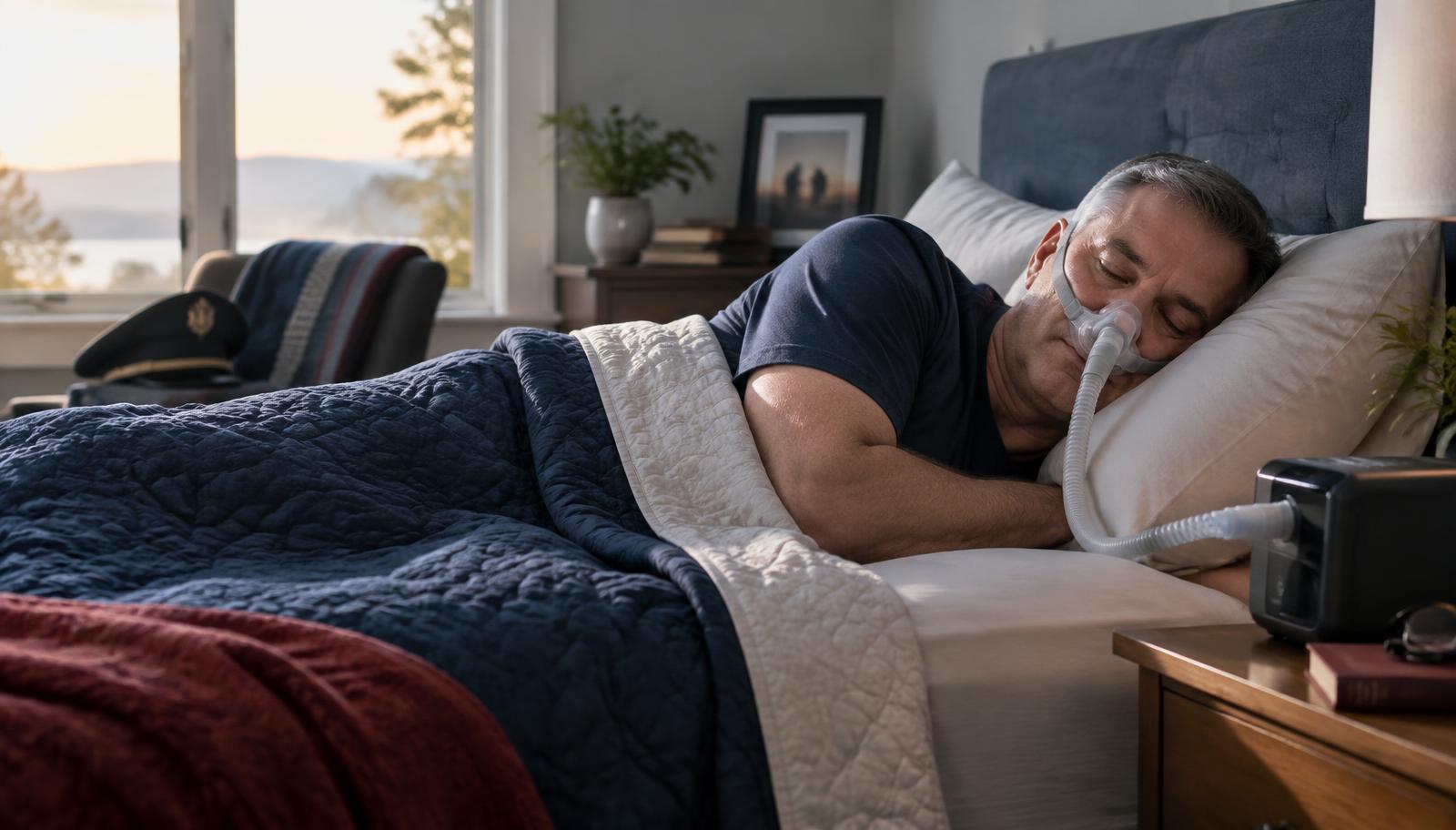

Waking up gasping or choking, loud snoring, witnessed pauses in breathing, morning headaches, daytime sleepiness, and trouble concentrating can be warning signs of sleep apnea. These symptoms are worth discussing with a medical provider because sleep apnea can repeatedly interrupt breathing during sleep.
For a VA disability claim, having sleep apnea is only the first part of the analysis. The evidence must also connect the diagnosed condition to military service or to an already service-connected disability.
What is sleep apnea?
Sleep apnea is a sleep disorder in which breathing repeatedly stops and starts. A sleep study is commonly used to confirm the diagnosis and document its type and severity.
- Obstructive sleep apnea (OSA): the upper airway becomes blocked during sleep, often when tissue in the throat relaxes or collapses.
- Central sleep apnea (CSA): the brain does not consistently send the signals needed to control breathing.
- Complex or mixed sleep apnea: obstructive and central breathing events occur together.
How sleep apnea is diagnosed and treated
A diagnosis is typically confirmed through an overnight sleep study or an appropriate home sleep apnea test ordered by a medical provider. The results may include an apnea-hypopnea index, oxygen levels, and the number and type of breathing events recorded during sleep.
Treatment depends on the diagnosis and the individual. A provider may prescribe continuous positive airway pressure (CPAP), another positive-airway-pressure device, an oral appliance, lifestyle changes, surgery, or a combination of approaches. A CPAP keeps the upper airway open by delivering pressurized air through a mask while the person sleeps.
Can sleep apnea be a VA disability?
Yes. The VA may grant service connection when the evidence shows that sleep apnea began during service, is otherwise linked to an in-service event or exposure, or was caused or aggravated by an already service-connected disability. A diagnosis by itself does not establish that link.
The facts and medical reasoning must be specific to the veteran. A general study showing an association between two conditions does not automatically prove that one caused the other in a particular case.
The three elements of direct service connection
A direct sleep apnea claim generally needs three elements. When the diagnosis came years after separation, credible evidence describing symptoms during service can help a qualified clinician evaluate whether the current condition is related to that period.
- A current diagnosis of sleep apnea, generally confirmed by a sleep study
- An in-service disease, injury, event, exposure, or onset of relevant symptoms
- A medical nexus connecting the current sleep apnea to military service
Evidence that may support a direct connection
Service treatment records may not use the words “sleep apnea.” The record may instead contain reports of disrupted sleep, fatigue, headaches, breathing problems, or other relevant symptoms. Evidence should be accurate and consistent with the veteran's actual history.
- The diagnostic sleep study and current treatment records
- Service treatment and personnel records relevant to onset, symptoms, injury, or exposure
- Statements from roommates, family members, or fellow service members who observed loud snoring, gasping, choking, or pauses in breathing
- A veteran's own statement describing when symptoms began and how they continued after service
- A reasoned medical opinion that reviews the relevant record and explains the connection
Where veterans start
Every case is different, and there is no obligation at any step. When veterans want to understand what their records actually support, these are the two most common starting points:
- Medical records review
A licensed physician reviews your records for a $250 flat fee and identifies which conditions the available evidence may support. The fee is refunded in full if nothing supportable is identified.
- Nexus letter
When the records support one, a licensed provider writes the medical opinion that addresses the link between your condition and your service.
Secondary service connection for sleep apnea
Under secondary service connection, the question is whether an already service-connected disability caused sleep apnea or made it worse beyond its natural progression. Causation and aggravation are separate medical questions, and a complete opinion should address the pathway supported by the veteran's record.
Veterans commonly explore sleep apnea secondary to PTSD, sleep apnea secondary to rhinitis or sinusitis, and sleep apnea secondary to tinnitus and sleep disruption. None of these theories is automatic. The opinion must explain the medical mechanism, address relevant risk factors, and apply supporting research to the veteran's history.
Obesity as an intermediate step
Obesity is not itself a VA disability for compensation purposes, but it may be considered as an intermediate step in some secondary-service-connection claims. For example, the evidence may examine whether a service-connected condition or its treatment caused or aggravated weight gain, whether that weight gain was a substantial factor in developing sleep apnea, and whether the sleep apnea would have occurred without it.
This is a fact-intensive theory. A medical opinion should address other risk factors and avoid assuming that weight alone explains the diagnosis.
Current VA sleep apnea ratings
Under the current rating schedule in 38 CFR 4.97, Diagnostic Code 6847, the VA evaluates sleep apnea at 0, 30, 50, or 100 percent. Our sleep apnea VA ratings guide walks through each level in detail, and recent and proposed rating changes explains what may change. The VA can revise rating criteria, so confirm the rules in effect when the claim is decided.
- 0%: documented sleep-disordered breathing without symptoms
- 30%: persistent daytime hypersomnolence
- 50%: requires a breathing-assistance device such as a CPAP machine
- 100%: chronic respiratory failure with carbon dioxide retention or cor pulmonale, or requires a tracheostomy
A CPAP prescription does not establish service connection
A prescribed CPAP may be relevant to the disability rating after service connection is established. It does not, by itself, prove that sleep apnea is related to service. The service-connection decision and the percentage evaluation answer two different questions: why the condition is connected and how the VA rates its severity under the schedule.
What a strong sleep apnea nexus opinion should do
A useful medical opinion does more than repeat a diagnosis or cite articles. It identifies the claimed pathway, reviews the veteran's relevant records, considers competing risk factors, explains the medical mechanism, and reaches a conclusion using the VA's “at least as likely as not” standard when supported. Our guide to the medical evidence behind a sleep apnea claim shows what that record usually looks like.
Patriot NEXUS Letters provides independent medical evidence, not legal representation or claim filing. A paid medical records review can help determine whether the available evidence supports a medically defensible opinion before a nexus letter is ordered.
Frequently asked questions
Is sleep apnea a VA disability?
Sleep apnea can be service connected, but a diagnosis alone does not establish it. The evidence must show that the condition began in service, was aggravated by service, or was caused or aggravated by an already service-connected condition.
What VA rating does sleep apnea get?
Under Diagnostic Code 6847, sleep apnea is rated at 0, 30, 50, or 100 percent. The 50 percent level applies when the condition requires a breathing-assistance device such as a CPAP machine. Our ratings guide explains each level.
Does a CPAP prescription prove service connection?
No. A CPAP prescription documents treatment - it does not establish when the condition began or what caused it. Service connection is a separate question from treatment, which is why the evidence in your records matters.
Can sleep apnea be connected secondary to PTSD?
Yes. Under 38 CFR 3.310, a condition caused or aggravated by an already service-connected disability can be service connected on a secondary basis. Whether the evidence supports that connection is a medical question - see our guide to sleep apnea secondary to PTSD.