
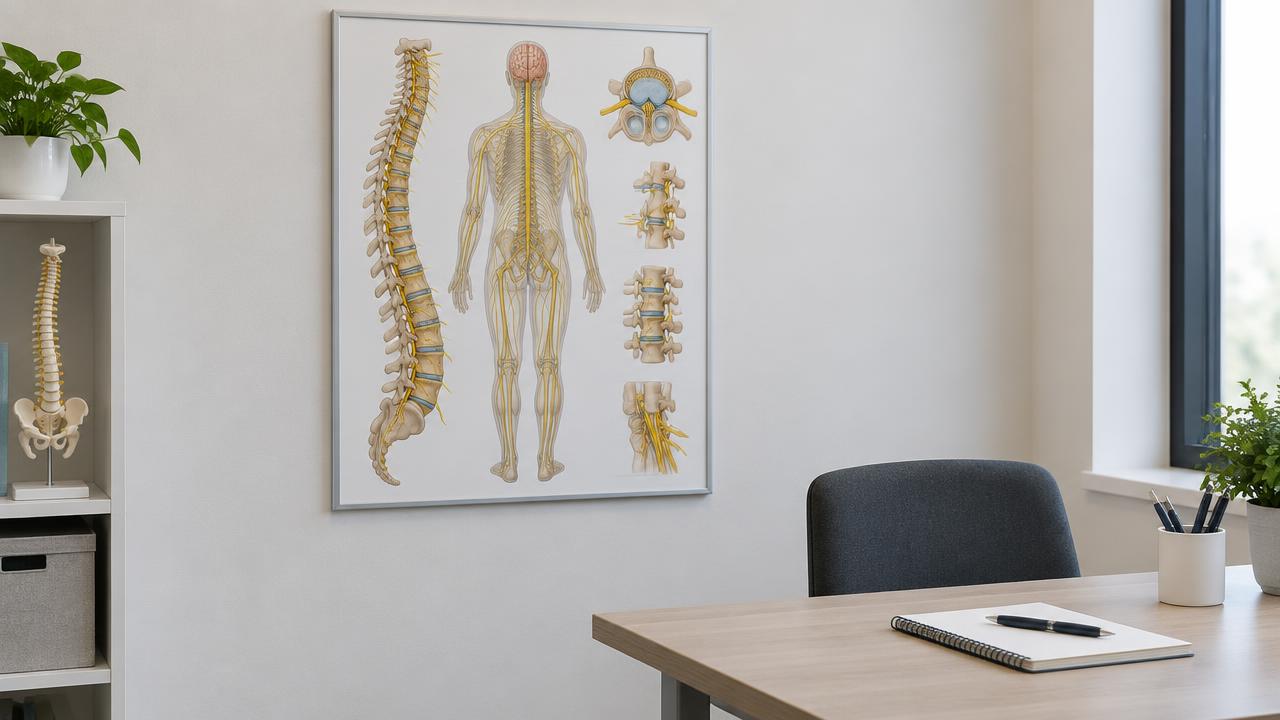

Peripheral nerve ratings are set by two things: which nerve is involved, and how far the loss of function has gone. 38 CFR 4.124a lists each nerve with a ceiling for complete paralysis and graded levels of incomplete paralysis below it.
The words the schedule uses - mild, moderate, moderately severe, severe - are not defined by numbers the way range of motion is. That makes the clinical description in your records unusually important, which is the point our nerve claim evidence guide develops.
Diagnostic Code 8520 - Sciatic nerve
This is the code most radiculopathy claims run through. Incomplete paralysis rates 10 percent when mild, 20 percent when moderate, 40 percent when moderately severe, and 60 percent when severe with marked muscular atrophy. Complete paralysis, where the foot dangles and drops, no active movement of the muscles below the knee is possible, and knee flexion is weakened or lost, rates 80 percent.
Each leg is rated separately. Two legs at 20 percent do not make 40 percent; they combine under 38 CFR 4.25, and the bilateral factor may also apply. Our sciatica VA rating guide covers this code in depth.
Diagnostic Code 8620 and 8720 - Sciatic neuritis and neuralgia
Every paralysis code has a matching neuritis code 100 numbers higher and a neuralgia code 200 numbers higher. Sciatic neuritis is 8620 and sciatic neuralgia is 8720. The percentages come from the same table, but 38 CFR 4.123 and 4.124 cap what neuritis without objective findings and neuralgia can reach: the equivalent of moderate incomplete paralysis.
Diagnostic Code 8526 - Femoral nerve
The femoral, or anterior crural, nerve serves the front of the thigh. Incomplete paralysis rates 10 percent when mild, 20 percent when moderate, and 30 percent when severe; complete paralysis with paralysis of the quadriceps extensor muscles rates 40 percent. Upper lumbar radiculopathy at L2 through L4 often presents here rather than through the sciatic code.
Diagnostic Codes 8521 to 8525 - Lower leg and foot nerves
The external popliteal, or common peroneal, nerve at Diagnostic Code 8521 rates 10 percent for mild, 20 percent for moderate, and 30 percent for severe incomplete paralysis, with 40 percent for complete paralysis where foot drop and loss of dorsiflexion are present.
The anterior tibial nerve at 8523 and the posterior tibial nerve at 8525 each reach 30 percent for complete paralysis, and the internal popliteal nerve at 8524 reaches 40 percent. Foot and ankle nerve findings are often recorded loosely, which is why our feet and lower legs series is worth reading alongside this one.
Where veterans start
Every case is different, and there is no obligation at any step. When veterans want to understand what their records actually support, these are the two most common starting points:
- Medical records review
A licensed physician reviews your records for a $250 flat fee and identifies which conditions the available evidence may support. The fee is refunded in full if nothing supportable is identified.
- Nexus letter
When the records support one, a licensed provider writes the medical opinion that addresses the link between your condition and your service or an already service-connected disability.
Diagnostic Codes 8510 to 8512 - The radicular groups
Cervical radiculopathy is frequently rated through the radicular groups: the upper radicular group at 8510, the middle radicular group at 8511, and the lower radicular group at 8512. These codes are rated higher for the dominant, or major, arm than for the minor arm, a distinction set by 38 CFR 4.69.
For the upper radicular group, incomplete paralysis of the major arm rates 20 percent when mild, 40 percent when moderate, and 50 percent when severe, with 70 percent for complete paralysis. The minor arm percentages sit a step below. Our cervical radiculopathy guide explains how the neck level maps to each group.
Diagnostic Codes 8514 to 8516 - Radial, median, and ulnar nerves
The musculospiral, or radial, nerve at 8514 reaches 70 percent for complete paralysis of the major arm. The median nerve at 8515 rates 10 percent for mild, 30 percent for moderate, and 50 percent for severe incomplete paralysis of the major arm, with 70 percent for complete paralysis; this is the code carpal tunnel claims usually run through. The ulnar nerve at 8516 rates 10, 30, and 40 percent for the major arm with 60 percent for complete paralysis.
Arm and hand nerve claims often sit beside an orthopedic claim. Our shoulder and arm series covers the joint side, including the brachial neuritis guide.
The wholly sensory rule
The note preceding the peripheral nerve codes in 38 CFR 4.124a states that when the involvement is wholly sensory, the rating should be for the mild, or at most the moderate, degree. This single sentence explains most disputes over nerve percentages.
Numbness and tingling with normal strength and reflexes is a mild or moderate picture. Weakness on manual muscle testing, a diminished or absent reflex, and measurable atrophy of the calf or thigh are the findings that support moderately severe and severe. If those findings exist, they belong in the treatment record, not only in your description at the exam.
How the percentages combine
Nerve ratings for each limb are separate evaluations. A veteran with a lumbar spine rating and radiculopathy in both legs has three evaluations that combine under 38 CFR 4.25, with the bilateral factor applied when both lower extremities are involved.
What the schedule does not allow is rating the same impairment twice. 38 CFR 4.14 prohibits pyramiding, so a single symptom cannot support both a neuritis code and a neuralgia code for the same nerve. Read the pillar guide for how these pieces fit together in a whole claim.
Sources
- 38 CFR 4.124a - Schedule of ratings, neurological conditions and convulsive disorders (eCFR)
- 38 CFR 4.123 - Neuritis, cranial or peripheral (eCFR)
- 38 CFR 4.124 - Neuralgia, cranial or peripheral (eCFR)
- 38 CFR 4.69 - Dominant hand (eCFR)
- 38 CFR 4.25 - Combined ratings table (eCFR)
- 38 CFR 4.14 - Avoidance of pyramiding (eCFR)